




We Love an Origin Story. What About Accountability?
Why Aaron Sorkin’s The Social Reckoning deserves our attention, even if it doesn’t receive the same admiration as The Social Network.
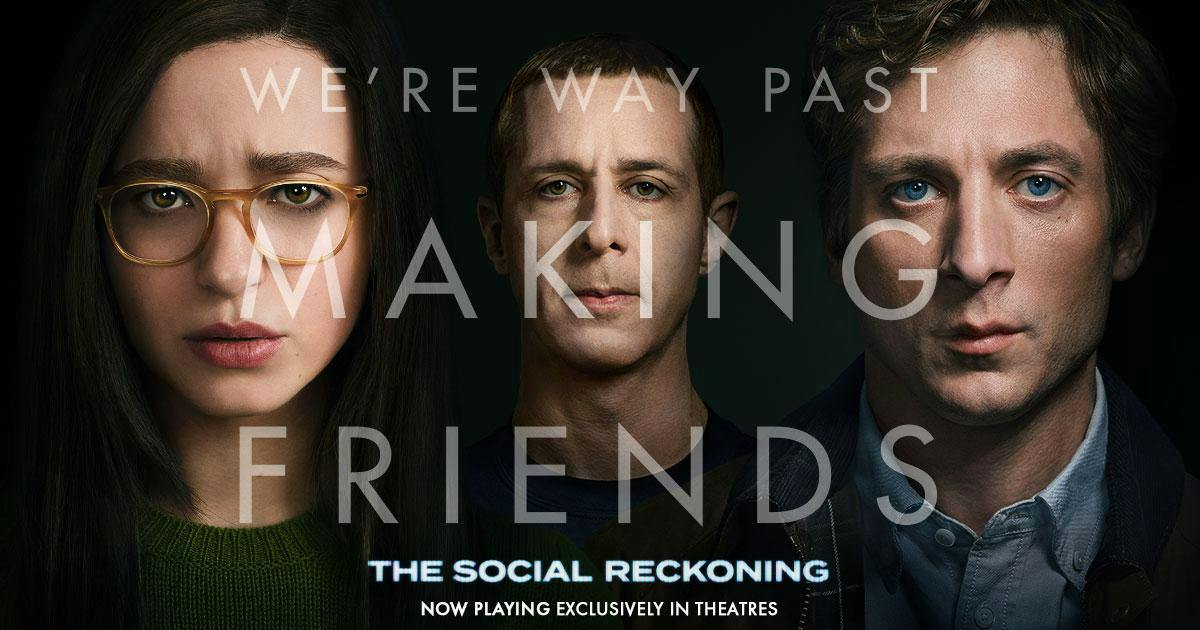
I walked out of the theater after watching Aaron Sorkin’s The Social Reckoning (trailer below) thinking about how much we, particularly as Americans, love an origin story. We celebrate the people who build companies, disrupt industries, and change the way we live. We turn their ambition into entertainment, their success into inspiration, and sometimes their personalities into mythology.
But what happens when the story shifts from what someone built to the consequences of building it?
I’m not sure we’re nearly as interested in that part.
In 2010, The Social Network gave us a dramatized account of Facebook’s beginnings. It wasn’t particularly flattering to Mark Zuckerberg, but it was compelling. David Fincher’s direction, Aaron Sorkin’s extraordinary dialogue, and Trent Reznor and Atticus Ross’s score made for a film that was as much a cinematic achievement as it was a story about ambition, friendship, betrayal, and the creation of a company that would fundamentally change the world.
Sixteen years later, Sorkin has returned to Facebook with The Social Reckoning, this time writing and directing a film about what happened after the company became one of the most influential institutions on the planet.
And while I don’t think the new film achieves everything its predecessor did cinematically, I walked away believing its story may be even more important.
The Story We Don’t Particularly Want to Hear
There’s something inherently exciting about watching someone build something extraordinary. We know how to celebrate entrepreneurship. We admire ambition, reward innovation, and often measure success by the size of the company someone creates.
I’m an entrepreneur myself. I understand the appeal of building something from nothing, making difficult decisions, and pursuing an idea that other people might not understand. But I’ve also come to believe that the larger a company becomes, the greater its responsibility should be to the people affected by its decisions.
The Social Reckoning asks us to confront that responsibility.
Rather than focusing on Facebook’s creation, the film centers on the people who helped expose what was happening inside the company, including whistleblower Frances Haugen and Wall Street Journal reporter Jeff Horwitz.
This isn’t simply a story about whether Mark Zuckerberg is a good person or a bad one. Frankly, I don’t find that question particularly interesting. What interests me is what happens when a company’s pursuit of growth and profitability comes into conflict with the well-being of the people who use its products.
And what happens when the company has become so influential that its decisions affect people who never consciously agreed to participate in its ecosystem?
Those are questions worth asking, regardless of how anyone feels about Zuckerberg or Sorkin.
Journalism Is More Than the Ability to Publish
One of the aspects of the film that resonated with me most was its treatment of investigative journalism.
I earned my degree in broadcast journalism. Part of what drew me to the field was the belief that journalism, at its best, is rooted in integrity. That reporting comes with a responsibility to investigate, verify, question, and seek the truth, even when doing so is difficult or unpopular.
That belief hasn’t changed.
What has changed is the environment in which information is distributed.
Social media has given virtually anyone the ability to document an event, publish an account, and reach an audience. In many respects, that’s an extraordinary development. There are stories we know about today precisely because ordinary people had the ability to record something and share it with the world.
I don’t want to diminish that. Access to information and the ability to document what happens around us are important.
But the ability to publish information is not the same thing as the responsibility to verify it.
Somewhere along the way, I think we’ve become far too comfortable treating the two as interchangeable.
There’s a moment in the film involving the disruption of traditional journalism that stayed with me. The concern isn’t simply that Facebook and other digital platforms have taken attention, advertising revenue, or jobs away from newspapers. It’s that these platforms have fundamentally changed the way people encounter information without necessarily assuming the editorial responsibilities traditionally associated with distributing news.
A reporter working for an established publication is supposed to operate within a system of standards, editors, sourcing requirements, corrections, and accountability. Those systems aren’t perfect. Journalism has always had its failures, biases, and shortcomings. But the existence of those standards matters.
When information circulates through a platform primarily designed to maximize engagement, the incentives are different. Something doesn’t have to be accurate to spread. It has to capture attention.
And those are two very different objectives.
When Engagement Becomes More Valuable Than Truth
One of the most troubling questions raised by the film is what happens when a company recognizes that certain information may be harmful but has financial incentives not to meaningfully intervene. Facebook’s historical decisions around political advertising and fact-checking are particularly relevant here.
I understand the complexities of moderating speech at an enormous scale. I understand that determining what is true isn’t always straightforward, particularly when dealing with political claims, competing interpretations, and evolving information.
I also believe there are legitimate concerns about allowing private corporations to become the ultimate arbiters of public discourse. But acknowledging those complexities doesn’t eliminate the company’s responsibility.
When a platform profits from the distribution of information, especially information that can influence elections, public health, and people’s perceptions of one another, I don’t believe it can simply distance itself from the consequences of that distribution.
There is a difference between protecting freedom of expression and building a business model that benefits when inflammatory, misleading, or divisive content keeps people engaged.
And I think we should be willing to examine that difference.
The film left me thinking about how much influence we’ve handed to companies whose primary obligation, at least in the conventional understanding of corporate governance, is to create value for shareholders.
Which brings me to something much larger than Facebook.
The Problem With Putting Shareholders First
I don’t believe profitability is inherently bad. I don’t believe capitalism is inherently incapable of producing good outcomes. I’ve spent much of my adult life building businesses, employing people, and making decisions that require balancing financial performance with other responsibilities.
But I do question a system in which financial performance can become the justification for decisions that impose enormous costs on society.
At what point does a company’s responsibility to humanity outweigh its responsibility to shareholders?
That’s not a rhetorical question for me.
Because if a company can generate extraordinary returns while the broader public absorbs the consequences of its decisions, I think we have to ask whether we’re measuring success appropriately.
We celebrate market capitalization, revenue growth, user acquisition, and shareholder returns. We make lists of the wealthiest founders and the most valuable companies. We treat those metrics as evidence of extraordinary achievement.
But what are we measuring when we talk about the cost?
The erosion of trust in information? The spread of misinformation? The consequences of algorithms that reward outrage? The effects on democratic institutions and public discourse?
Those outcomes are considerably harder to capture in a quarterly earnings report. That doesn’t make them any less real.
And it certainly doesn’t mean they should be secondary considerations simply because addressing them might reduce engagement or profitability.
A Film Doesn’t Have to Be Perfect to Be Important
I’ve seen commentary suggesting that Sorkin’s return to Facebook is driven by some personal dislike of Zuckerberg.
Maybe he dislikes him. Maybe he doesn’t. I have no idea, and I don’t particularly care.
The value of the story doesn’t depend on the filmmaker’s personal affection for its subject.
Of course, dramatizations should be scrutinized. Creative liberties matter, and audiences should distinguish between documented events and the choices a screenwriter makes to tell a compelling story.
But dismissing the film as a personal vendetta seems like an awfully convenient way to avoid engaging with the questions it raises.
I’m an enormous Aaron Sorkin fan. His dialogue, pacing, and ability to construct arguments through characters are among the reasons I consistently seek out his work.
And I can appreciate The Social Reckoning without pretending it’s a better cinematic achievement than The Social Network.
The absence of Fincher’s direction and that unforgettable Reznor and Ross score is noticeable to me. Those elements contributed considerably to what made the original film special.
But artistic achievement and cultural importance aren’t always the same thing.
A film can be imperfect and still tell a story we need to confront. In fact, sometimes the stories that make us most uncomfortable are the ones most worth telling.
We Should Be Willing to Watch the Reckoning
I suspect The Social Reckoning won’t inspire the same affection as The Social Network.
Perhaps that’s partly about the filmmaking. Perhaps it’s about the familiarity of the subject. Or perhaps it’s simply easier to enjoy a story about the creation of something revolutionary than to confront what that revolution has cost. I don’t know.
What I do know is that I left the theater thinking less about whether Sorkin had made another masterpiece and more about the responsibility we assign to the people and institutions that shape our lives.
Facebook isn’t just a company that allows people to share photographs, connect with friends, or discover content. It is part of an information ecosystem that influences how millions of people understand the world.
That kind of influence deserves scrutiny.
And when journalists, whistleblowers, filmmakers, or anyone else brings forward information that challenges the narratives we’ve accepted about powerful institutions, I think we owe it more than an immediate dismissal.
We owe it our attention, our curiosity, and our willingness to ask difficult questions.
We love celebrating the entrepreneurs who change the world.
We should be just as willing to examine the consequences of what they’ve built.





Read the Comments +